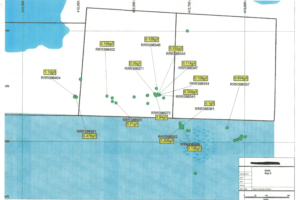
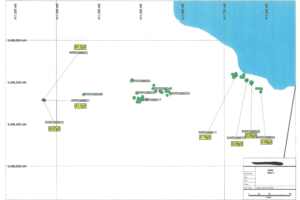
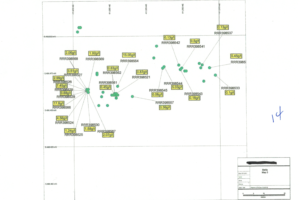
While going through the historical paperwork from the recently acquired group of claims relating to the Stella Lake showing I found these old maps of exploration dated February 1931. They show areas that we were not aware of marked “New Discovery”. We have explored the main areas looking at the old shafts and trenches and spent some time at the area marked “tunnel”. We found the well-hidden tunnel and entered the opening to find it was very stable and went into the rock formation a total of about 105 feet. We gathered some grab samples from the stringer quartz that lined the walls with some assaying at 1-6 oz. and one just outside the opening of the adit assaying a 96 oz. There is a cribbed shaft at the opening that shows a depth of 65′ in front of the adit. The shaft is filled with water so we couldn’t gather any samples at this time. We have plans to expose the old vein at this location to get to untouched rocks for further assay samples. The “new discovery” marked on this old map shows the area on surface just north of the adit, but still probably connected to the adit vein below at a depth of about 30-40 feet. It has never been looked at for exploration by us. (We didn’t even know it existed). We will have the equipment at the location early this summer for possible exposure of a new extension of the gold bearing quarts veins at the Stella.
Just south of the Stella showing we found 7 old pits that were filled with water so we couldn’t do anything until we pump the shafts out. From surface we could see rusty quarts veining that looks promising. We also found old mapping that has been marked “new discovery” also, again we didn’t try to expose this as we ran out of season but we will be looking again when weather permits.
We are hoping that this area may show a connection between the Wendigo gold, silver and copper producer that poured the last gold bar in 1943. (See the Wendigo reports on this site too.) None of this area has had in-depth drilling but, the Wendigo did have very good gold, silver and copper at 200′ plus. Just to the east of the Stella is the Kite Lake showing that showed high grade gold assays at the three pits. The pits are not filled to the top with water and we can see a quart vein about 18″ wide from the top. We have a (Kite Lake report) attached also. Just west and south a bit we came across another well-hidden pit that were able to gather some samples from and got very good assay results.