Witch Bay Mines
These claims include most of the historical GOLD showings in the “Greenstone Belt” southeast of Kenora Ontario. These claims have continuous gold showings for about 3K and a width of about 1K. The project is fully permitted with much work done and a large exploration program is planned as soon as the weather permits. We have already moved equipment (excavator, loader, and dozer) to the site and will be concentrating on the extensions of exposure of the high-grade assays from grab samples. (Grab sample assay reports are attached).
The history of gold in this area goes back to the turn of the century, we have put together a claims package that includes the old, recorded showings at Stella Lake, Blue Star, Jenny Leigh, Kite Lake, Beck, Fort Knox and the Trigg’s showings from that time. After years of exploration, we were able to add the Pacific Iron property recently to make everything continuous for the 3K. Just to the south of this project is the Wendigo Mine that produced gold, silver, and copper until 1943 ( a picture of the last bar is on here). 67,000 oz. Gold, 14,760 oz. silver an 1,866,246 lb. of copper. The average gold was .33 oz. Per ton.
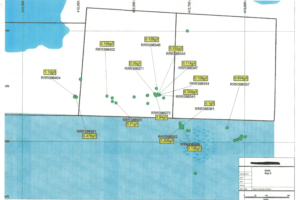
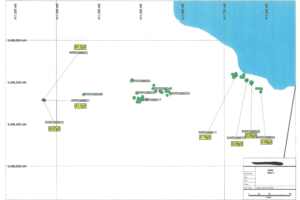
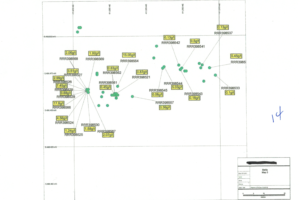
The maps show the “Greenstone Belt” and Faultline south of Kenora from Mining Ontario marked with gold, silver, and copper deposits. One of the deposits was the Kite Lake deposit. The assays from here were exceptionally good and will be a target for future stripping. We will be posting new pictures and assay results after we start working this spring…
Stay tuned. Doug
The big gold producers and most geologist say the next big gold discovery will come from a previous discovery that was never explored at depth. We are looking for a company that is in a position to take our years of work and knowledge of this project to the next level. The object of this material is to enter into an option agreement with a company that is willing to put the money in the ground. This project is FULLY PERMITTED and ready to go. Contact Doug@ontariogoldproject.ca for more information and set up a meeting as the weather breaks and gold prices keep going up.
Triggs Mine
On the same belt as the Stella, with similar formation and ore bodies, is the Triggs mine, situated east of Witch bay on a fairly good wagon road about 2 mile in length extending from a small lake which is crossed by canoe shortly Triggs Mining Company after leaving the landing at Witch bay. The property consists of three locations, McA56, 129 and 148, aggregating 113 acres. It is owned and operated by the Triggs Gold Mining Company of Ontario, Limited. President, F.D. Sargeant, St. Paul. Minn.; vice-president J.W. Millar, Rat Portage; secretary and treasurer, J.H. Triggs, Rat Portage. I visited the place in August. Work has been going on since October, 1897, under the management of J.H. Triggs, secretary of the company. The workings are confined to an elevated portion of ground 40 to 50 feet in height, about 150 feet in width and from 700 to 800 feet in length, surrounded by low, swampy ground. The formation is fine grained trap. The richest ore is confined to veins, and consists of zones of quartz and greenstone mixed, extending along the top of the hill with a strike of nearly east and west. There are two of these veins, one on the north and the other on the south side of the hill, about 150 feet apart: but the manager has made The other 6 repeated tests, resulting in the conclusion that gold is contained to a sufficient extent and sufficiently diffused to warrant treatment of the whole mass between the veins. the quartz in the veins assays exceptionally high, and the greenstone between gives promising returns.
No. 1 vein, on the south side, has been exposed by a number of small test pits two or three feet in depth, sunk at frequent intervals, extending over a distance of several hundred feet. Oxidized material is revealed in most cases, with from a few inches to two feet of quartz. A shaft has been sunk on the vein to a depth of 80 feet, but was not in operation and was partially full of water at the time of my visit, preventing ingress. At a depth of 40 feet a drift has been driven eight feet west along the vein. Mr. Triggs informed me that the shaft followed a very rich pay streak for the greater part of the distance, but this dipped so flatly near the bottom that sinking was continued in the foot “wall. Several hundred tons of rich ore have been dumped separately at the surface, awaiting the erection of a mill. A neat collar and a ladderway have been provided, and a temporary shaft house built. On No. 2 vein, which is traceable for 500 to 800 feet along the northside of the hill, two test pits have been sunk: one 10 feet deep revealed four feet of vein matter consisting of quartz and “greenstone, charged with pyrites and said to assay well. The other,70 or 80 feet west, was six feet in depth and 14 feet in length, exposing about 10 feet of vein matter; the vein branched aggregating about five feet in width. Iron and copper pyrites were abundant and assays w. re satisfactory. Near the foot of the hill, on the north side, a tunnel was commenced which was in tended to be dr. ven through to the south side, cutting both veins. I learned later from Mr. Triggs that this had been driven 40 feet, and work at the mine suspended, with the intention of commencing again during the winter. The force consisted of three miners and a cook. Boarding camps, a stable and a black smith shop had been built.
The Triggs mine closed down on July 14, owing to lack of capital for further development work. One hundred tons of the low grade ore have been brought in for treatment at the Keewatin Reduction Works, and if ^2.50 per ton, or more, is obtained, the result will be considered satisfactory. Mr. Triggs has hopes in the event of such being the case, of being able to obtain sufficient capital for the further necessary development of the mine by the sale of treasury stock. The capital of the company is $500,000, divided into 100,000 shares wit a par value of each. Twenty thousand shares are in the treasury, and these cannot be sold at less than par value. Mr. Triggs gave me the following underground measurements since the closing down of the mine: Main shaft; depth 225 feet, First level: depth, 108 feet. No. 1 crosscut, driven northwest from shaft, 58 feet. Drifting in crosscut at distance of 51 feet from shaft; length 206 feet; direction, west. Drifting from about same point in crosscut, in same drift, at a distance of 186 feet from No. 1 crosscut; length, 58 feet; direction, southeast; driven towards air shaft, which is 242 feet from the main shaft, and 61 feet deep, vertical dip. A crosscut has also been driven 19 1/2 feet northwest from the same drift at a distance of 51 feet from No.1 crosscut. Second level: depth, 208 feet: crosscut, northwest from shaft, 29 1/2 feet, Drifting from end of crosscut, 59 feet west and 50 feet east. Total length or amount of development work on property, 826 feet. Other shafts have been mentioned in previous reports of the Bureau.


Kite Lake Mine
Mineralization Comments
Nov 22, 2017 (R Tuomi) – 1970 drilling best intersection assayed 0.38% Cu and 0.02% Ni over 1.2 m. Mineralization included pyrite, pyrrhotite and chalcopyrite. Sheared mafic metavolcanic rocks only lithology intersected. Silicification predominant alteration type. 1990: Chip samples assayed: 2.15% Cu over 2m; and 1.55% Cu over 1.5m. Host rock was shared mafic metavolcanic rocks and gabbro.
Nov 22, 2017 (Theresa Pettigrew) – Fine-grained basalt underlies an area south of Kite lake. Near the southernmost tip of Kite Lake, an east-striking zone of schist and breccia, from 1-2 m wide and dipping south at from 50-70 degrees contains some carbonate and one or more quarts veins and lenses with a maximum width of 45 cm. The quartz is fractured, encloses minor silicified basalt, and contains abundant chalcopyrite and pyrite in and near some of the fractures. Two shafts about 30m apart have been sunk on the zone. A chip sample across 50 cm of the mineralized quartz vein at the east shaft assayed 1.93 opt Au. A third shaft was put down a further 75 m t the east. A fourth shaft was sunk on a separate zone approximately 100 m to the SW. The best intersection reported from DDH 70-2 where a 3.8 ft interval from 89.0-92.8 feet assayed 0.38% Cu, 0.02% Ni, 0.06 opt Au and 0.10 opt Ag. McLaren for Rexora in 1950 wrote that “two veins, each about 500 ft. long are found in a wide shearing… four shaft were sunk in the early work to various depths on these veins”. McLaren also stated that a bulk sample was taken by Rexora, partly at the 50′ level at one shaft and partly from surface. The pulp from this bulk sample was shipped to a number of assayers with highly variable results. Of 15 separate assays the gold assayed at 0.22 to 3.28 opt Au, the silver assayed 0.71 to 4.26 opt Ag, and 2.37% to 11.28% Cu (AFRI 52E09SE0012). Sample 57906 near the No. 2 shaft in 2011 assayed 1.260% Cu, 11.55 ppm Au, and 20.1 ppm Ag. The best nickel assay was 125.5 ppm Ni from sample 57907 (AFRI20000007065). Pyrite, pyrrhotite and chalcopyrite mineralization occurs in silicified and sheared Early Precambrian andesitic volcanic rocks.